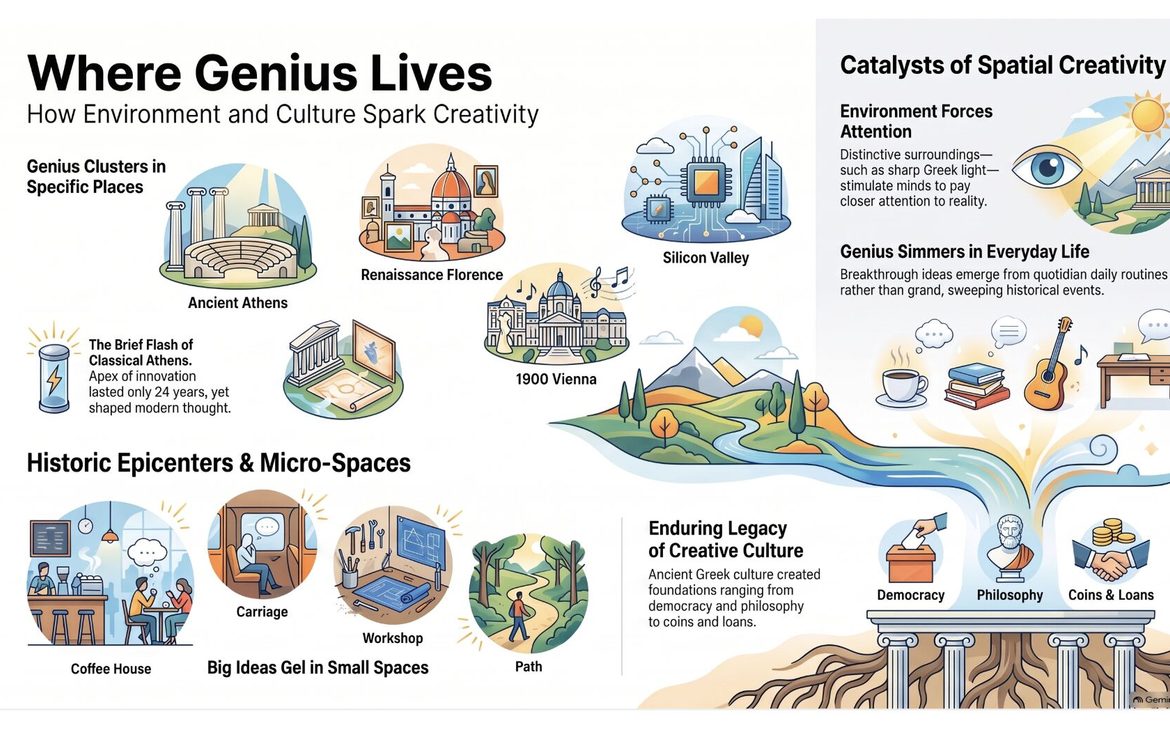
Athens. Florence. Vienna. Edinburgh. Silicon Valley. India. ?
We look at these places and assume they were simply full of brilliant people. Eric Weiner’s The Geography of Genius made me wonder if we have the causal direction backwards.
First, WHAT is genius? (Not who)
The word comes from Latin. To the Romans, a genius wasn’t something you were. It was something you had: a guiding spirit attached to a person, a family, or even a place (the genius loci, the spirit of a place).
I can’t tell you how many times when I tell my story I begin with the garden that I grew up in.
Somewhere along the way, we turned genius ..into a fixed trait of Rare Individuals. (We started the separation from the land n the environment)
Weiner argues the older meaning was closer to the truth, and I agree. Genius is less a gift of birth and more a product of circumstance: what a culture values, rewards, and makes possible. How many more artists would we have if we saw this connection, instead of believing “I am not an artist”?
He borrows a line from Plato that sums it up “What is honoured in a country will be cultivated there.”
Locally, what is appreciated and celebrated becomes the culture.
So let’s look at the environment
The places that produced genius had things in common. Weiner points to three conditions he calls the three Ds:
🔹 Disorder: Enough instability and openness to shake up old assumptions
🔹 Diversity: Different people, ideas and cultures colliding
🔹 Discernment: The ability to separate the good ideas from the noise
None of these are personality traits. They are properties of an environment.
We put this in VUCA and have been dealing with it as a problem, trying to “fix” it, instead of seeing these as conditions for genius.
Now put the same person in two places..
– In one, questions are welcomed, failure isn’t fatal, and curiosity is rewarded.
– In the other, mistakes are punished, hierarchy is rigid, and conformity pays.
Would we expect the same work? Of course not. Yet when performance differs, we blame the individual first.
We don’t blame a seed for failing to grow in a desert. With people, we do it all the time.
Agency matters.
But agency is also influenced by conditions, and conditions either amplify it or consume it.
W. Edwards Deming said “A bad system will beat a good person every time.”
So the leadership question shifts:
From – Why isn’t she innovative? → To Is innovation actually safe here?
From – Why doesn’t he speak up? → To What happens to people who disagree with the boss?
From – How do we motivate people? → To What are we currently incentivising?
Two question to sit with :
1. Think of the place where you grew teh most-what were the conditions?
2. Of the three Ds (Disorder, Diversity, Discernment), which one is your organisation still treating as a problem to fix, rather than a condition to cultivate